
Chess Guides & Advice · · 4 min read
What Size Chess Board Should You Choose? Squares, King and Numbers
Squares too small and the pieces crowd together; too large and the set looks lost on the board. Here is how to match the chess board size to your pieces, with a table of the usual formats No. 3 to No. 6.
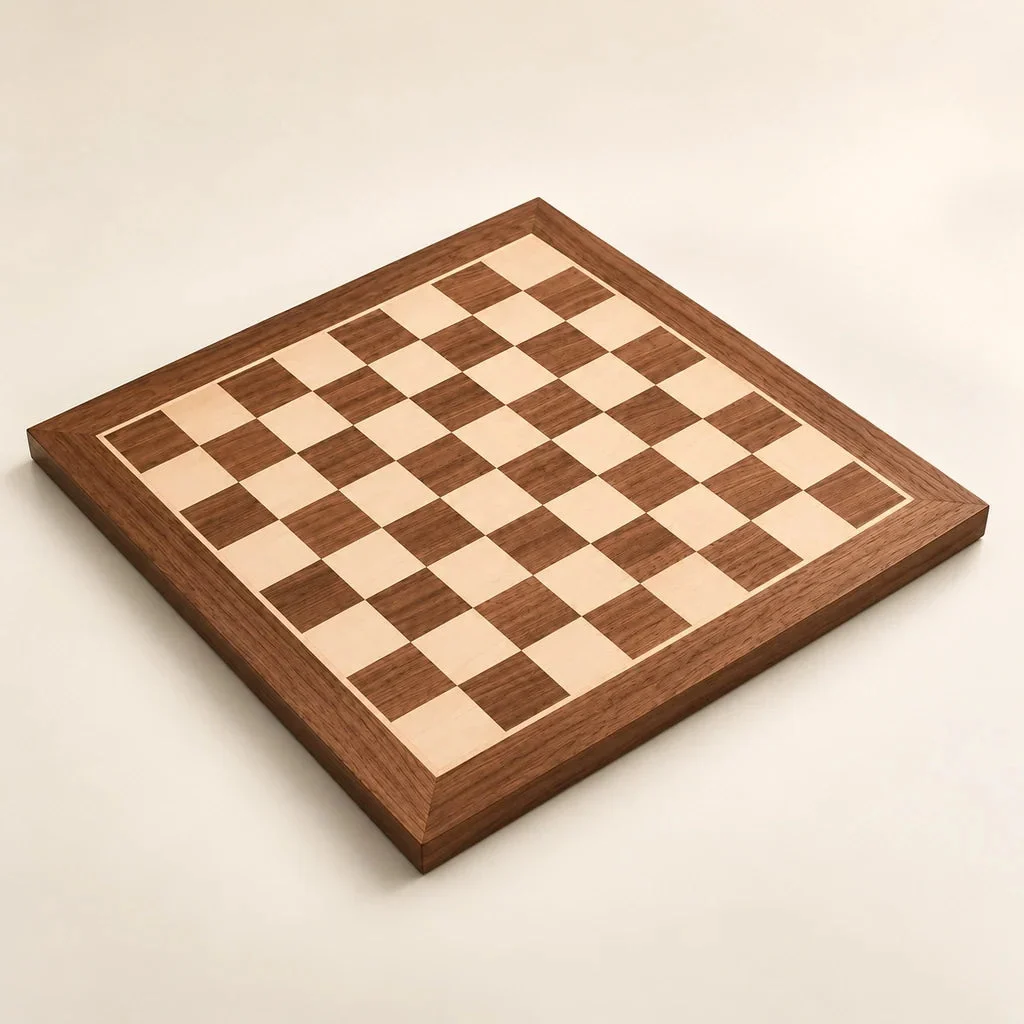
Choosing a chess board on its own, or checking that a complete set is well proportioned, almost always comes down to the same question: are the pieces comfortable on their squares? A king that is too wide spills over; pieces that are too small seem to float on a large board. The good news: there are simple rules of thumb for finding the right chess board size, whether you play on a living-room table, at a club or while travelling.
The golden rule: the square and the king's base
It is not the height of the pieces that matters first, but the width of their base. The king, the largest piece, is the reference:
- the king's base generally takes up about 75 to 80% of the width of the square;
- put another way, the square measures about 1.25 to 1.3 times the diameter of the king's base.
Example: a king whose base measures 32 mm will be comfortable on squares of around 40 to 42 mm. There is enough space around each piece to pick it up without knocking over its neighbours, without the board looking empty.
In top-level competitions, the recommendations of the International Chess Federation (FIDE) refer to squares of 5 to 6 cm and a king of about 9.5 cm. For playing at home or at a club, slightly smaller formats are quite common.
And the king's height?
King height is the measurement manufacturers most often give, because it speaks to everyone. On a well-proportioned Staunton-style set, it goes hand in hand with the base: a taller king has a wider base. In practice, allow roughly twice the width of the square for the king's height: an 80 mm king on 40 mm squares, a 90 to 100 mm king on 50 mm squares.
These ratios vary with the design of the pieces: a set with slender silhouettes may have a taller king for the same base. Rely first on the base when it is given.
The usual formats, from No. 3 to No. 6
Chess sets and boards are often referred to by a number, particularly in France. These numbers are not strictly standardised: the dimensions below are common orders of magnitude, which vary from one maker to another.
| Format | King height (approx.) | Square (approx.) | Board (approx.) | Typical use |
|---|---|---|---|---|
| No. 3 | 65 to 75 mm | 30 to 35 mm | 30 to 35 cm | Compact set, children, small table |
| No. 4 | 75 to 85 mm | 40 mm | 40 to 42 cm | Family set, practice, club |
| No. 5 | 85 to 95 mm | 45 to 50 mm | 45 to 50 cm | Club, tournament, great comfort |
| No. 6 | 95 to 105 mm | about 55 mm | 50 to 55 cm | Large format, decoration, living room |
The board measures slightly more than eight squares along each side, because it generally has a border, wider still when it carries coordinates.
A size 4 or a size 5 chess board?
No. 4, the versatile format
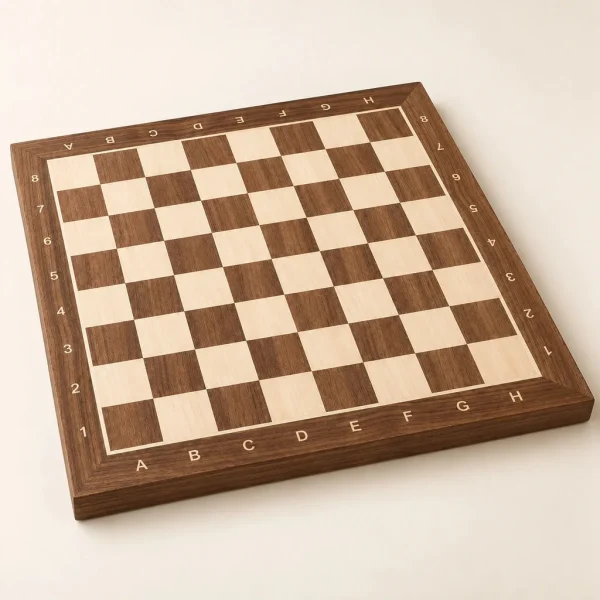
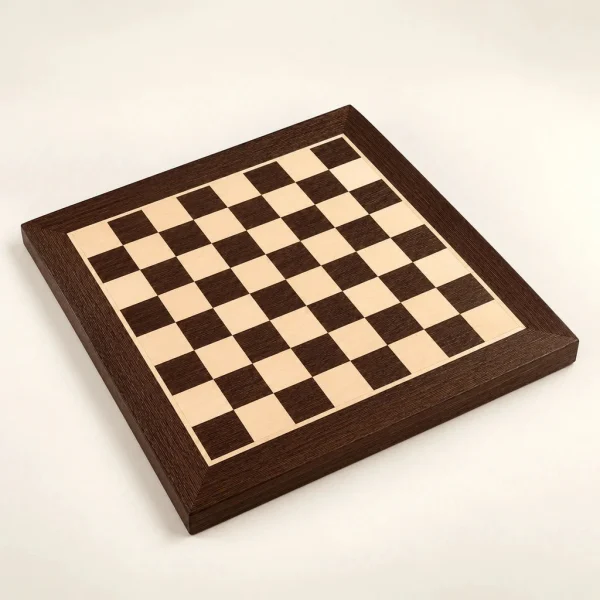
With its 40 mm squares, the No. 4 chess board fits on an ordinary table and leaves room for a clock and a scoresheet. It takes pieces whose king measures around 75 to 85 mm. Our No. 4 walnut and sycamore chess board with coordinates (40 cm, 40 mm squares) is well suited to study, and the No. 4 wenge and maple offers a cleaner version without coordinates. Among complete sets, the Régence No. 4 brings together weighted pieces with an 80 mm king and a marquetry board.
No. 5, tournament comfort
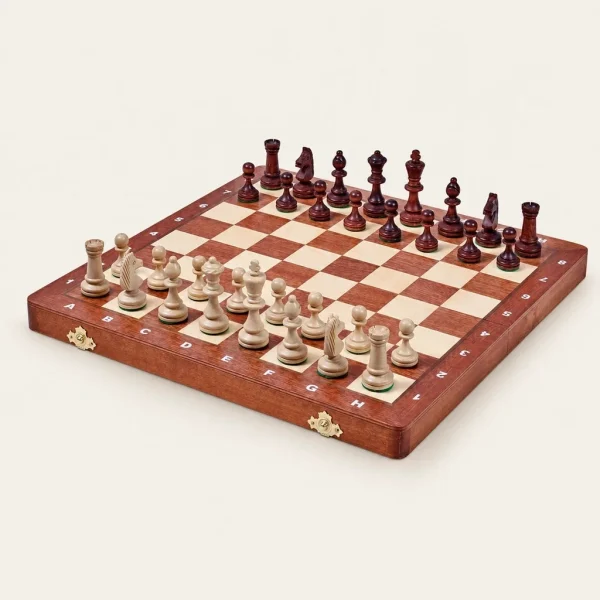
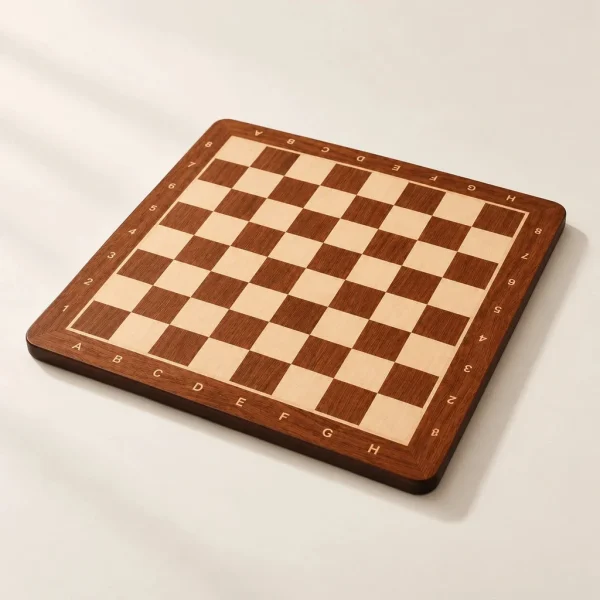
No. 5 gives the pieces more room and comes closer to competition formats. Our No. 5 padauk and maple chess board measures 48 cm, with 50 mm squares and alphanumeric coordinates, for No. 5 Staunton pieces. The complete set the Régence No. 5 pairs a 90 mm king with a folding marquetry board.
Choosing well for how you will use it
- Small table or desk: a No. 3 or No. 4 stops the board overhanging.
- Club and tournament: No. 4 or No. 5, with Staunton-style pieces and, if possible, coordinates for recording moves.
- Decoration: a large format, beyond No. 5, has more presence on a coffee table.
- Travel: a compact magnetic set, with 20 to 30 mm squares, remains the most practical.
- Children: pieces with a wide base, easy to grasp, rather than very tall pieces.
If you are buying a chess board on its own for pieces you already own, simply measure the diameter of your king's base and multiply it by 1.25 to 1.3: this gives you the ideal square width. Our chess board guide also explains the set-up and how to find your way around the squares.
One last piece of advice: think about the space around the board. For a game with a clock, allow around twenty centimetres on each side for the clock and the captured pieces. A 48 cm No. 5 chess board therefore needs a table at least 70 to 80 cm wide to play comfortably, whereas a No. 4 will make do with a more modest table.
Frequently asked questions
What chess board size for pieces with an 80 mm king?
Squares of around 40 mm, that is, a No. 4 chess board of roughly 40 to 42 cm along each side. Do check the king's base too if it is given.
Can you put No. 4 pieces on a No. 5 chess board?
Yes, it is playable, but the pieces will look a little small and the whole less harmonious. The reverse, pieces too large for small squares, is more of a nuisance.
Are the coordinates on the board useful?
They help a great deal in learning notation, recording your games and following a book or a lesson. For purely decorative use, a board without coordinates looks more understated.
Conclusion
Remember just one rule: the square should be about 1.25 to 1.3 times the king's base. The rest, No. 4 or No. 5, is a matter of space and taste. Compare the dimensions of each board in our chess board collection, or choose a matching set directly from our complete chess sets.