
Chess Guides & Advice · · 5 min read
Jacquet or Backgammon: What Are the Differences?
Jacquet and backgammon are played on the same board, with fifteen checkers and two dice, but the spirit differs: one favours the race and the block, the other the fight and the doubling cube. Here is how to tell them apart.
Open a backgammon case in a French family home, and there is a good chance an older relative will suggest "a game of jacquet" instead. The board is the same, the dice too, but the game does not play out at all in the same way. Jacquet belongs to the great family of tables games, very popular in France until the 19th century, like tric-trac. Here is what sets it apart from backgammon, and how to choose the one that suits you.
One family, two philosophies
Backgammon and jacquet are racing games: each player moves their fifteen checkers around a board of 24 points, at the roll of two dice, then bears them off once they have all reached their last quarter. This family is one of the oldest in the world: the Royal Game of Ur, found in Mesopotamia, or the Roman tabula, played on 24 squares, are distant cousins.
What changes is how you interact with your opponent. Backgammon is a game of combat: you hit lone checkers, send them to the bar, take risks. Jacquet is a game of caution and precision: you never hit, you block, and you win above all by managing your dice better than the other player.
The main differences at a glance
| Aspect | Backgammon | Jacquet |
|---|---|---|
| Starting position | Checkers spread over four points (2-5-3-5) | All 15 checkers stacked on a single point |
| Direction of movement | The two players move in opposite directions | Both players move in the same direction of rotation, from opposite corners |
| Opponent's lone checker | It can be hit and goes to the bar | You never hit |
| Holding a point | Two checkers are needed to close a point | A single checker is enough to occupy a point |
| Doubling cube | At the heart of the modern game | Absent from the tradition of the game |
| Atmosphere | Tactics, risks, reversals | Racing, blocking, patience |
How a game of jacquet unfolds
The start: a single stack
In jacquet, each player starts with all fifteen checkers together on a single point, in one corner of the board. The two stacks face each other diagonally, in opposite corners. The whole game consists of "unrolling" this stack, moving it forward towards your bearing-off quarter.
The same direction of rotation
Unlike backgammon, where the checkers meet head-on, both players here move in the same direction. The armies don't collide: they chase each other. This changes everything about how you think about the game, because you try to position yourself in front of your opponent to hinder them rather than to attack them.
Blocking instead of hitting
Since you never hit, the only weapon is the block. A point that is occupied, even by a single checker, is forbidden to the opponent. By skilfully occupying several points in front of their checkers, you force them to play moves that suit them poorly, or even to miss a turn. This is why it is called a game of precision: every move counts, and a poor distribution is paid for several turns later.
Bearing off
As in backgammon, once all your checkers are gathered in your last quarter, you bear them off the board according to the dice. The first to bear off all fifteen checkers wins.
The detailed rules of jacquet vary from one region or family to another, notably for opening the stack and certain blocking restrictions. Before the game, agree on your house rules: it is the tradition of tables games.
A family resemblance to Greek tavli
In Greece, backgammon is called tavli, and a match generally strings together three games on the same board. Two of them shed good light on jacquet:
- Fevga: players start from opposite corners and move in the same direction; a single checker is enough to hold a point, and you never hit. This is the very spirit of jacquet.
- Plakoto: all the checkers also start from a single point, but you can pin a lone opposing checker by landing on it, which immobilises it.
- Portes: very close to backgammon, with the same starting position and the same principle for hitting and entering.
If you like jacquet, fevga will feel familiar; if you prefer combat, portes and backgammon will delight you.
Which to choose?
Jacquet, for serenity
With no hitting and no doubling cube, jacquet suits family games, players who like to calculate and those who are sometimes frustrated by the luck of the dice in backgammon. Reversals do happen, but they are slower and easier to read.
Backgammon, for intensity
Backgammon is livelier: a hit checker can turn a game around in a single roll, and the doubling cube adds a layer of bluff and risk-taking. It is also the game played at clubs and in tournaments. To learn all its subtleties, read our guide to the rules of backgammon.
Why not play both?
Good news: a single case is enough. Fifteen checkers of each color, two pairs of dice and a board of 24 points are exactly the equipment for both games. Only the doubling cube stays at the bottom of the case when you play jacquet.
The right board for jacquet and backgammon alike
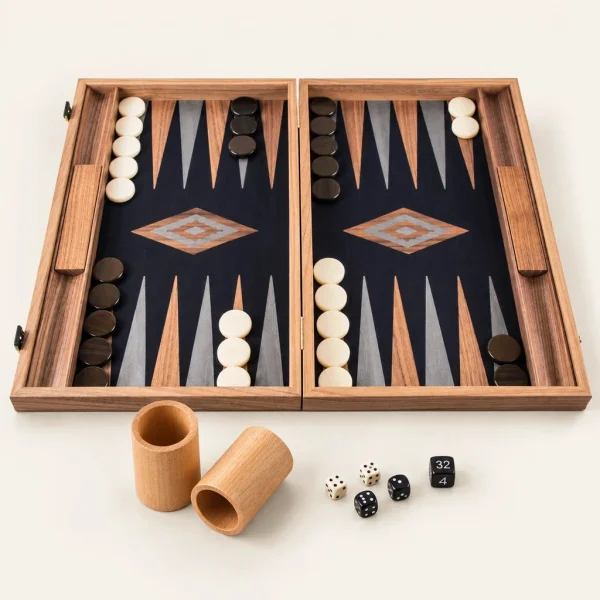
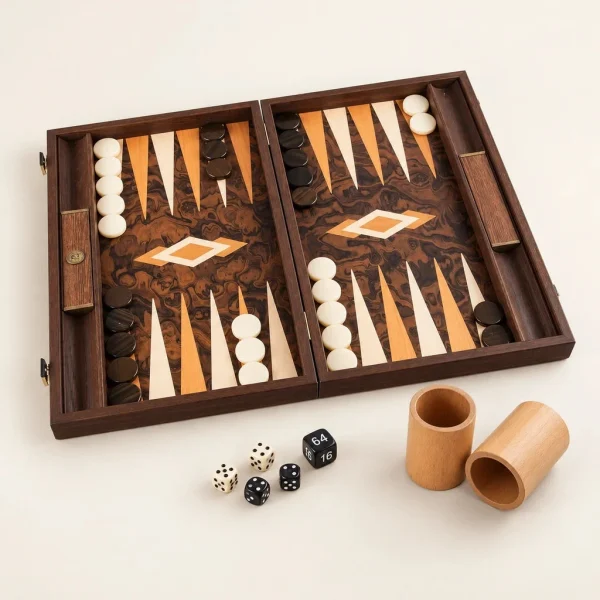
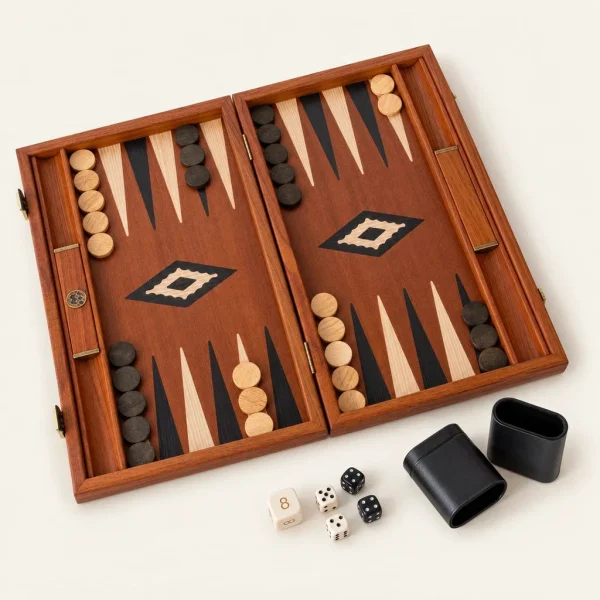
Our backgammon sets are handmade in Greece by the Manopoulos family (Athens, 1970, workshop in Thebes), with marquetry laid by hand. All include 30 checkers (15 light and 15 dark), 4 dice and a doubling cube: enough to play jacquet, backgammon and the three games of tavli. For regular family use, the BKB1 in walnut and black oak (48 × 30 cm closed) offers a large playing area. The BUU1 in California walnut burl will appeal to lovers of woods with dark shades, and the BMM2 in mahogany, in a medium size, goes easily on holiday.
Frequently asked questions
Can you play jacquet on a backgammon board?
Yes. The board, the fifteen checkers per player and the dice are the same; only the set-up and the way of playing change.
Is jacquet easier than backgammon?
Its rules are simpler, since you don't hit and don't use a doubling cube. But blocking your opponent well takes precision: easy to learn, demanding to master.
What is the difference between jacquet and tric-trac?
They are two old tables games that were very popular in France. Tric-trac, rare today, relies on a complex scoring system; jacquet is a more direct race to bear off.
Conclusion
Jacquet or backgammon, the real question is mostly: caution or combat? Jacquet rewards patience and precision, backgammon boldness and the calculation of risk. With a single beautiful board, you can switch from one to the other as the mood takes you. Discover our backgammon sets handmade in Greece to host all your games.