
Chess Guides & Advice · · 6 min read
Backgammon Rules: The Complete Guide for Beginners
Starting set-up, reading the dice, hitting checkers, bearing off, gammon and the doubling cube: here are the rules of backgammon explained step by step, with clear tables and practical tips for your first games.
Backgammon is one of the oldest board games in the world, and yet its rules fit on a single page. Two players, two dice, fifteen checkers each and a single mission: go right round the board and bear off all your checkers before your opponent. The luck of the dice gives the game its flavour, but it is how you play them that wins. Here are the rules of backgammon, in the order you will need them around the board.
The equipment and the vocabulary
The board has 24 points (also called "spikes" or "triangles"), divided into four quarters of six points. A central divider, the bar, cuts the board in two. Each player has:
- 15 checkers, light for one player, dark for the other;
- 2 dice and a cup to throw them;
- a shared doubling cube, the die marked 2, 4, 8, 16, 32 and 64 used to double the stakes.
Your home board (your "home") consists of the six points where you will bring all your checkers before bearing them off. The six neighbouring points, on your side, form your outer board. The points are numbered from 1 to 24 from each player's point of view: point 1 is the deepest in your home board, and 24 the furthest away. Each player moves their checkers from 24 towards 1, in the opposite direction to their opponent.
The starting position
Each player sets up their 15 checkers in the same way, counting from their own home board:
| Point | Number of checkers | Location |
|---|---|---|
| 24 | 2 | At the back of the opponent's home board |
| 13 | 5 | In the opponent's outer board (the "midpoint") |
| 8 | 3 | In your outer board |
| 6 | 5 | In your home board |
Remember the sequence 2-5-3-5. The two positions are perfectly symmetrical: your 5 checkers on point 6 face the opponent's 5 checkers on their point 13.
To decide who starts, each player rolls a single die. The higher roller plays first, using the two dice just rolled. In the event of a tie, roll again.
Moving your checkers
On your turn, you roll the two dice and move your checkers forward by the number of points shown on each of them.
- Each die is a separate move: with 5 and 2, you can move one checker 5 and another 2, or a single checker 5 and then 2, provided the intermediate point is open.
- Doubles are played four times: a double 4 gives four moves of 4.
- You can land on an empty point, on a point occupied by your own checkers (with no limit on the number) or on a point where the opponent has only a single checker.
- A point occupied by two or more opposing checkers is closed: you cannot land on it.
The obligation to play often surprises beginners: if both dice can be played, you must play both. If only one can be played, you play that one; if you have a choice between the two, you must play the higher. If no move is possible, you forfeit your turn.
Hitting, entering, blocking
Hitting a lone checker
A lone checker on a point is called a blot. If the opponent lands on it, they hit it: it is removed from play and placed on the bar. It will have to make the whole journey again from the start.
Entering from the bar
A checker on the bar must enter first, before any other move. It enters the opponent's home board, on the point matching the die: a 3 brings it in on the third point of the opponent's home board (the 22-point from its owner's side), provided it is not closed. If both dice point to closed points, you forfeit your turn, and your other checkers stay where they are.
Building points
Two or more checkers on the same point form a made point: it cannot be hit and it blocks the opponent. Six consecutive points form a prime, a wall that the opposing checkers cannot cross.
Bearing off and winning
As soon as all 15 of your checkers are in your home board, you can begin to bear them off the board:
- a die bears off a checker from the matching point: a 4 bears off a checker from point 4;
- if that point is empty, you must play the die inside the home board with a checker placed higher up;
- if there is no checker higher up, you bear off a checker from the highest occupied point;
- if a checker is hit during the bear-off, it must be brought back home before you resume.
Single game, gammon and backgammon
| Win | Condition | Points |
|---|---|---|
| Single | You bear off all your 15 checkers first. | 1 |
| Gammon | The opponent has not yet borne off any checker. | 2 |
| Backgammon | The opponent has borne off no checker and still has one on the bar or in your home board. | 3 |
The doubling cube: doubling the stakes
Invented in the 1920s by New York players, the doubling cube gave the game all its strategic depth. It starts in the center, on the 64 face, which counts as 1. At the start of their turn, before rolling the dice, a player who feels ahead can offer to double the stakes.
- The opponent accepts: the game is worth twice as much, and they take the cube on their side. Only they can offer the next double.
- The opponent declines: they concede and lose the stake at that point.
The cube can thus rise to 4, 8, 16… and its value multiplies the result: a gammon with the cube on 4 earns 8 points. A useful rule of thumb: it is generally right to accept a double as long as you keep at least a one-in-four chance of winning. In a match, the Crawford rule forbids the cube in the game that follows the moment a player comes within one point of victory.
Three tips for your first games
- Aim for the 5-point: with an opening 3-1, play 8/5 and 6/5. This point blocks your opponent and they cannot build it for you.
- Limit blots within direct range: a lone checker 6 points from an opposing checker can be hit by 17 combinations out of 36.
- Bring your back checkers round before they are shut in behind a prime.
To go further, our guide to the differences between jacquet and backgammon also presents the Greek variants of tavli, which are played on the same board.
Choosing a board to play on
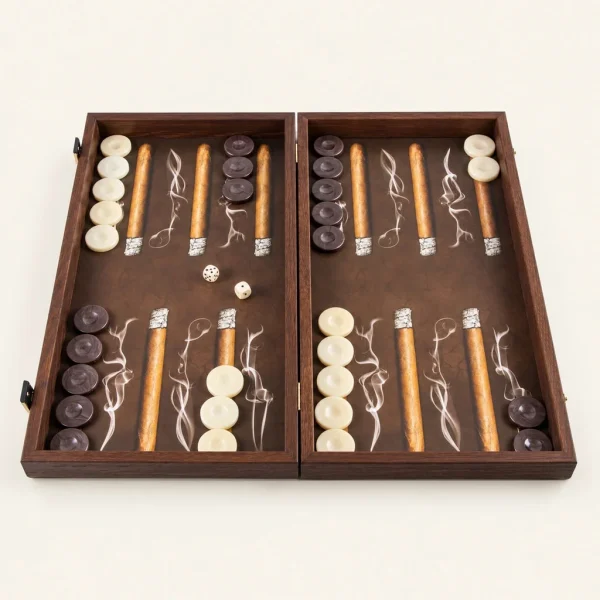
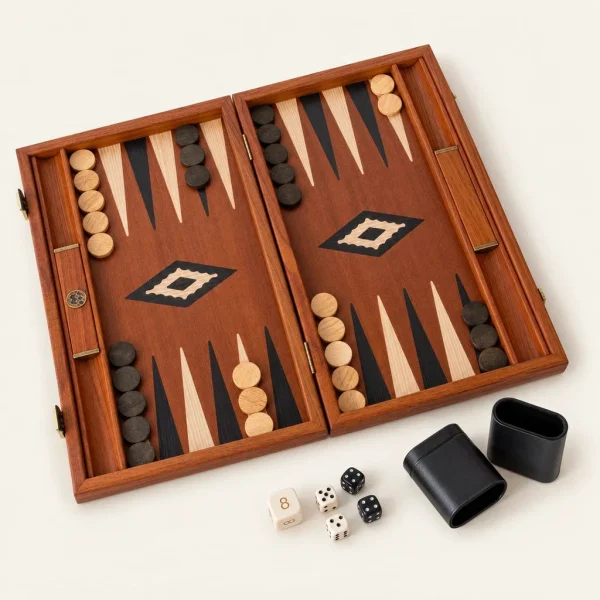
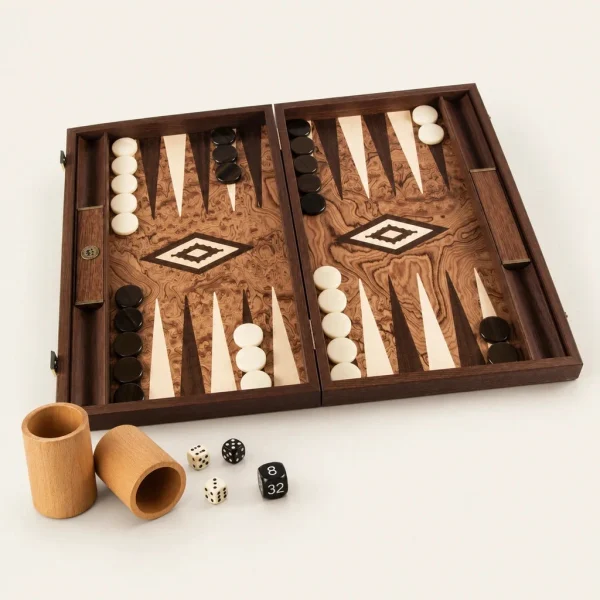
A good board makes the game easier to read: well-contrasted points, checkers that glide without catching, dice that roll cleanly. Our backgammon sets are handmade in Greece by the Manopoulos family, who settled in Athens in 1970 and whose workshop is in Thebes; the marquetry is laid by hand. To start without breaking the bank, the Robusto TXL1ROB includes 30 checkers, 4 dice, a doubling cube and dice cups. The medium BMM2 model in mahogany (38 × 23 cm closed) slips easily into a holiday bag, while the large BJJ1 model in walnut burl (48 × 30 cm) offers real playing comfort at home.
Frequently asked questions
Can you play one die and leave the other?
No, not if both can be played. You must use both dice when possible; if only one is playable, you play that one, and the higher if you have a choice.
How many checkers can you stack on a point?
As many as you like. However, as soon as the opponent has two checkers on a point, it is closed to you.
Is the doubling cube a compulsory part of the rules of backgammon?
No. When learning, people often play without it, simply counting wins, gammons and backgammons. You add it once the rules are well established.
Over to you
Set up your checkers in 2-5-3-5, roll the dice and let yourself be drawn in: a few games are enough for the rules of backgammon to become second nature. To find the board that will stay with you for a long time, discover our collection of wooden backgammon sets, with free delivery in 3 to 5 working days.