
Chess Guides & Advice · · 4 min read
How to Choose a Chess Clock: The Practical Guide
Mechanical or electronic, Fischer increment or Bronstein delay, blitz or long game: this guide helps you choose a chess clock suited to the way you play, at home or at the club.
A game of chess changes character as soon as you put a clock next to the board. Time becomes a resource to manage, just like the pieces: you learn not to dwell on an obvious move, to keep minutes for the critical moments, and endlessly drawn-out games disappear. You still need to choose the right model. Mechanical or digital, with or without increment, simple or programmable: here are the pointers for making the right choice.
What is a chess clock for?
A chess clock (also called a timer) combines two countdown timers in one case, one for each player. When you have made your move, you press your button: your time stops and your opponent's starts. The player whose time runs out loses the game, except in cases covered by the rules (for example if the opponent no longer has enough material to checkmate).
Beyond competition, the clock is a superb training tool: it teaches you to decide, to handle pressure and to make family games fairer, for example by giving the more experienced player less time.
Mechanical or electronic?
The mechanical clock
Two dials with hands, a mechanism to wind and a small flag that falls when the hand reaches the hour exactly: the mechanical clock has undeniable charm. On the other hand, it knows only one mode, the simple countdown, and it is harder to read precisely in the last seconds.
The electronic clock
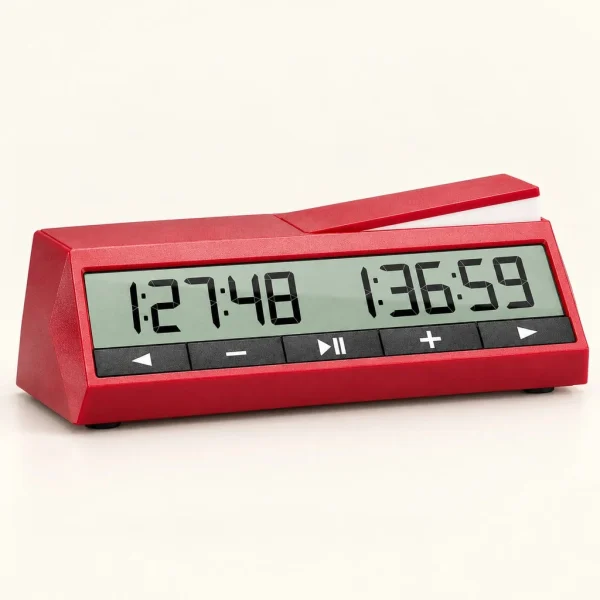
Digital models display the time to the second (sometimes to the tenth), keep the chosen time control in memory and, above all, handle increment and delay, which have become the norm in most competitions. For club play, or simply to vary the time controls at home, an electronic clock is today the most versatile choice. That is why all the chess clocks in our selection are digital.
Fischer increment, Bronstein delay: understanding the modes
| Mode | Principle | Who it suits |
|---|---|---|
| Simple countdown | Each player has a fixed time for the whole game. | Discovery, friendly games |
| Increment (Fischer bonus) | A fixed time is added after each move played (for example 2 seconds). | Blitz, rapid and long games at the club |
| Bronstein delay | After each move, you get back the time actually used, up to a set delay: you can never gain time. | Players who want to avoid endgames played "to the second" |
| Simple delay | The clock waits a few seconds before it starts counting down. | Variant close to Bronstein |
| Byo-yomi | Once the main time has run out, each move must be played within a fixed period. | Go and Japanese games, training |
The increment, devised by Bobby Fischer, profoundly changed the endgame: because a few seconds are added with every move, you no longer have to move the pieces any old how to avoid your flag falling. The delay, associated with the name of David Bronstein, pursues the same aim with slightly different logic: it protects the player in a hurry without allowing them to accumulate time.
Time controls, in general terms
A time control is often written as "minutes + seconds of increment": 3+2 means 3 minutes per player and 2 seconds added with each move. There are broadly three families:
- Blitz: a few minutes per player, up to around ten. Spectacular, nervy, ideal for having fun with friends.
- Rapid: in the order of 15 to 30 minutes per player, often with increment. A good compromise for serious practice in a reasonable time.
- Classical: an hour or more per player, often with increment or a second time period. This is the time control of "long" tournaments.
The exact boundaries between these families are set by the federations' regulations and may change: if you are preparing for a competition, always check the time control announced by the organiser.
The criteria for choosing well
- The modes available: without increment if you only play with family, with bonus and delay if you play, or intend to play, at a club.
- The presets: a clock with programmed time controls saves you from setting everything by hand before each game.
- Legibility: a large screen, even tenths of a second on display, helps enormously in tight endgames.
- The buttons: a rocker control or large, positive buttons are easier to find without taking your eyes off the board.
- Power: check the number of batteries and whether they are supplied.
Which DGT chess clock for which player?
To get started: simple and direct
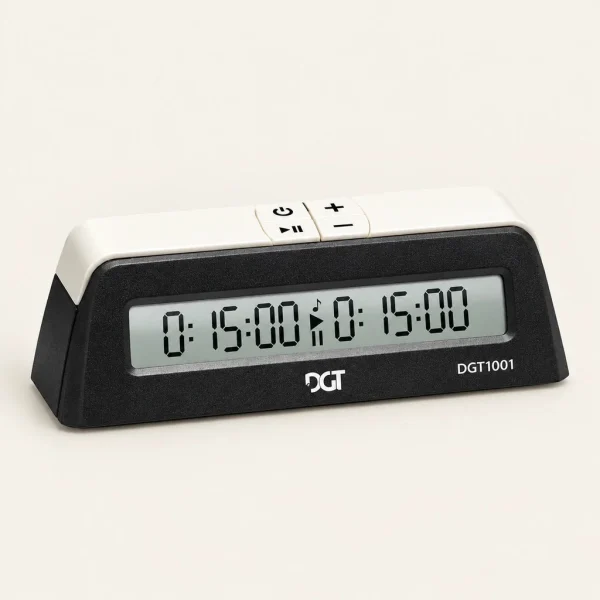
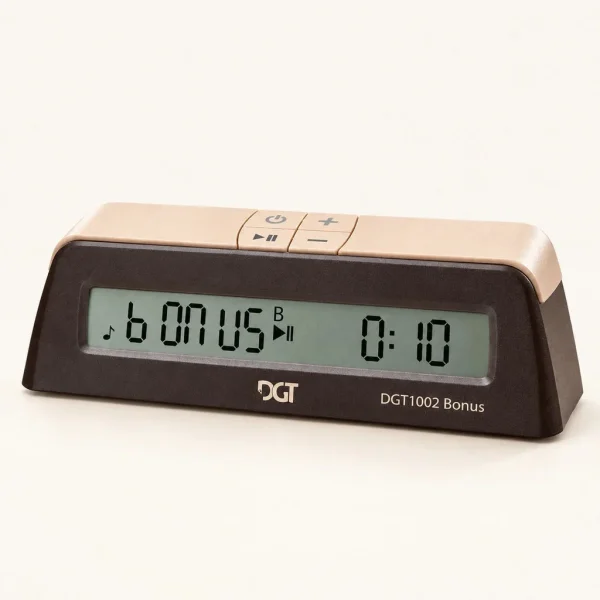
The DGT 1001 black offers countdown and count-up timing, with no bonus or delay, with two large buttons on the top. Ideal for discovering clock play with family. If you already want the increment, the DGT 1002 Bonus adds extra time after each move in an equally compact format.
To improve at a club
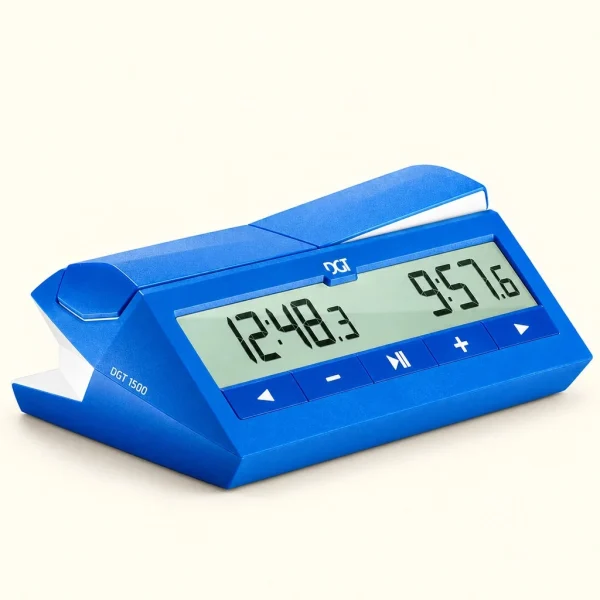
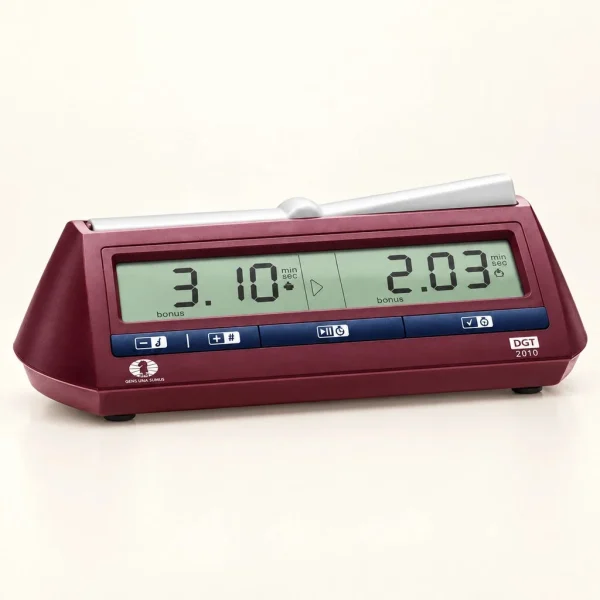
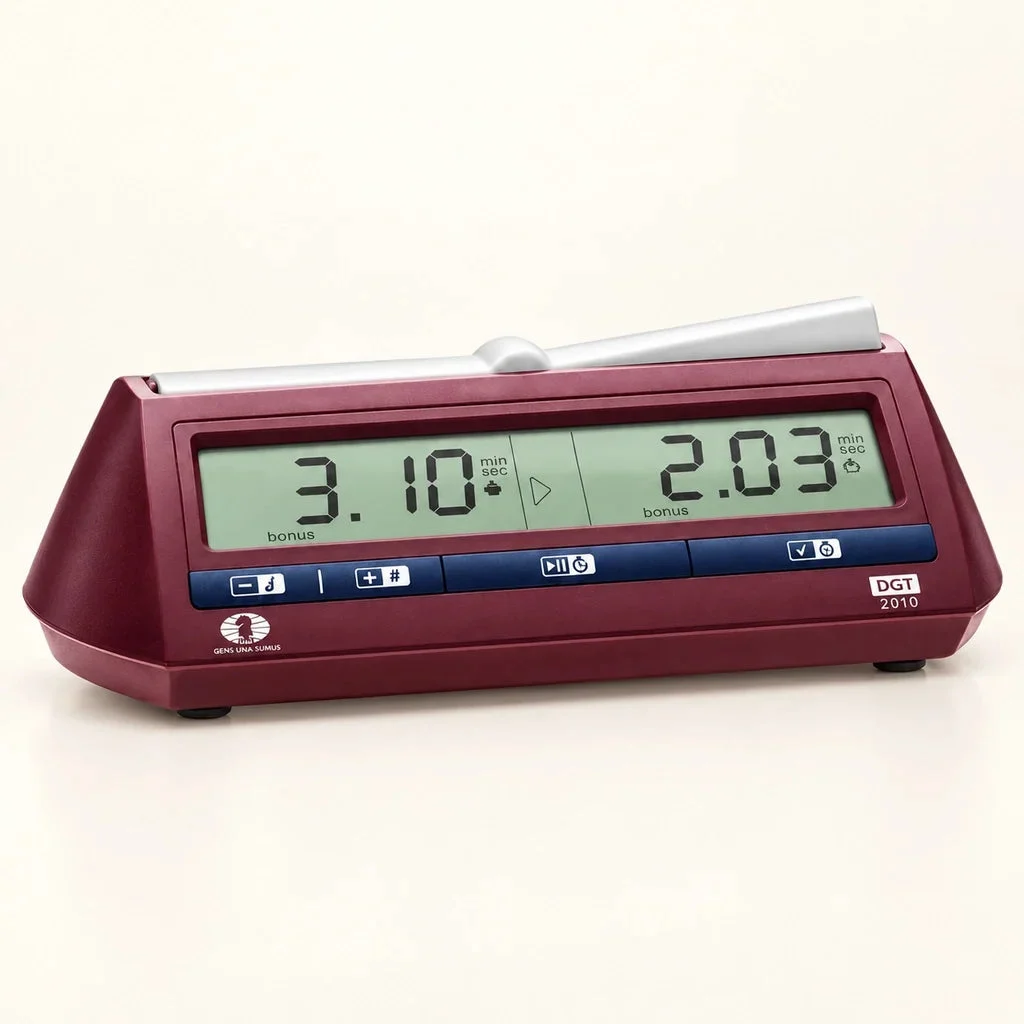
The DGT 1500 blue handles delay and bonus, lets you set each player's time separately and displays tenths of a second. The DGT 2010, with its characteristic blue buttons, offers 22 preprogrammed time controls, Fischer bonus, Bronstein delay and byo-yomi.
For ease of reading
The DGT 2500 stands out for its large 174 × 32 mm screen, its rocker control and its advanced functions: bonus, delay, multiple periods and a per-move timer.
Frequently asked questions
Which chess clock should I choose for a child?
A simple model with big buttons and a clear display is more than enough to start with. You can move on to a clock with increment when they play their first tournaments.
Can a chess clock be used for other games?
Yes, as long as it is a two-player game in which the players take turns. Some of our chess clocks even mention go or xiangqi in their features.
Should you always play with increment?
No, but it is strongly recommended as soon as games become serious: increment prevents a well-played game from being lost purely on the clock.
Conclusion
For playing with family, a simple model is enough; for the club and tournaments, favour increment, delay and good legibility. Compare modes, screens and presets in our chess clock collection, with free delivery in 3 to 5 working days.